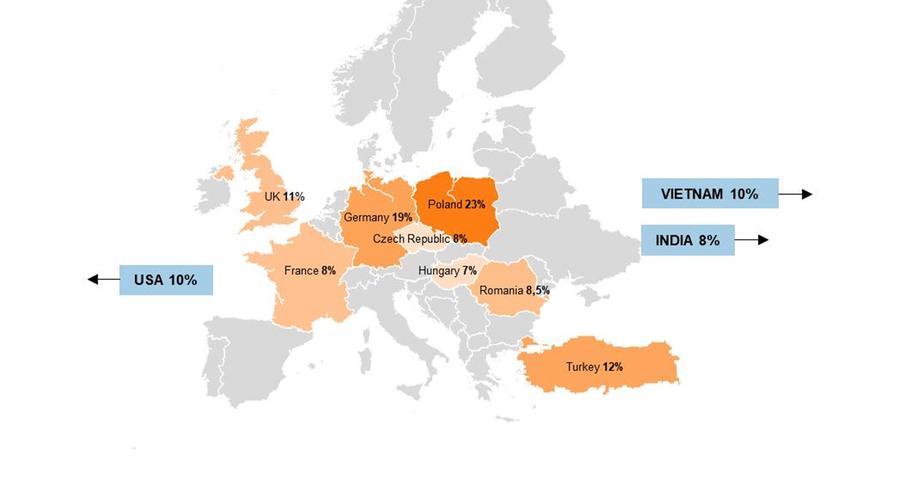
Poland is strengthening its position as one of Central Europe's most important destinations for foreign direct investment (FDI), supported by its large domestic market, strategic location, skilled workforce and growing role in European supply chains. As global companies rethink their manufacturing and operating strategies, Poland is increasingly being viewed not simply as a cost-competitive market, but as a strategic base for long-term expansion across Europe.
The country's economic scale is one of its greatest advantages. With a population of almost 40 million people, Poland offers international companies access to one of the largest consumer markets in Central and Eastern Europe. Its membership of the European Union also provides businesses with access to the wider single market, while extensive road, rail and logistics infrastructure continues to improve connectivity with Germany and other major European economies.
Poland Attracts Increasing Investment Interest
Investment activity in Poland has remained strong despite a more uncertain global economic environment. According to Deloitte, Poland accounted for approximately 39% of Central and Eastern Europe's M&A transaction volume in 2025, making it the largest market in the region by deal activity. The country's economic importance was further underlined in 2025 when Poland became the first Central and Eastern European economy to surpass $1 trillion in GDP.
The country's investment appeal has also continued into 2026. Recent regional investment data shows Poland accounting for 55% of CEE-5 investment volume during the first half of 2026, reinforcing its position as the dominant investment market in the region.
For international businesses, Poland's attraction comes from a combination of scale and strategic location. Companies can establish operations in Poland while remaining close to major Western European customers and supply chains.
Manufacturing and Supply Chains
Manufacturing remains one of the key pillars of Poland's FDI story. Automotive production, electronics, industrial equipment, appliances and logistics have all benefited from companies seeking to diversify and shorten their European supply chains.
The trend towards nearshoring has become particularly important. Global manufacturers are increasingly looking for production locations closer to their end markets following disruptions experienced across international supply chains in recent years.
Poland is well positioned to benefit from this shift. Its location between Western Europe and markets further east, combined with established industrial clusters and transport infrastructure, makes it attractive for companies looking to build or expand European production capabilities.
The country's extensive network of motorways, rail connections and logistics centres is also supporting the development of distribution and warehousing operations.
Technology Becomes Increasingly Important
Poland's investment story is no longer dominated by traditional manufacturing. Technology and business services have become increasingly important components of the country's economy.
Major international companies have established technology, research, shared-service and business-process operations in Polish cities including Warsaw, Kraków, Wrocław, Poznań and Gdańsk. A large pool of highly educated workers, particularly in engineering, information technology, finance and business services, has helped Poland develop into a major European services hub.
Artificial intelligence, cybersecurity, software development and advanced business services could become increasingly important areas for future FDI.
This represents a significant evolution in Poland's investment proposition. Rather than competing primarily on lower operating costs, the country is increasingly competing on talent, infrastructure, technological capability and access to European markets.
Energy and Strategic Investment
Energy is another sector attracting significant attention. Poland is undergoing a major transformation of its energy system, creating opportunities in renewable energy, electricity infrastructure, energy storage and other technologies.
International investors are increasingly interested in Poland's transition towards a more diversified and secure energy system. Large-scale renewable projects and supporting infrastructure could generate additional investment opportunities over the coming years.
Defence and strategic industries are also becoming increasingly relevant. Poland's geographical position and increased focus on national and European security have placed the country at the centre of discussions around defence manufacturing and strategic supply chains.
Challenges for Investors
Despite its strong investment position, Poland faces challenges.
Labour costs have increased as the economy has developed, reducing some of the cost advantages that initially attracted foreign manufacturers. Companies must also navigate regulatory requirements, energy costs, inflationary pressures and an increasingly competitive European investment environment.
Global trade tensions represent another potential risk. Poland's economy is deeply integrated into European manufacturing networks, meaning changes in international trade policy could affect exporters and manufacturers operating in the country.
Nevertheless, the country's economic fundamentals remain attractive for many international investors.
A Strategic European Investment Hub
Poland is entering a new phase of foreign investment. The country's competitive advantage is increasingly based on more than low costs. Its large domestic market, EU membership, skilled workforce, infrastructure, industrial capabilities and strategic location are creating a broader investment proposition.
As companies continue to rethink supply chains and seek greater resilience, Poland is well positioned to capture a larger share of European investment.
The coming years could therefore mark an important period for the Polish economy. If investment continues flowing into manufacturing, technology, energy, logistics and strategic industries, Poland could further establish itself as one of Europe's most important investment destinations.
For global companies looking for a combination of market scale, talent, infrastructure and access to the European Union, Poland is increasingly difficult to overlook.