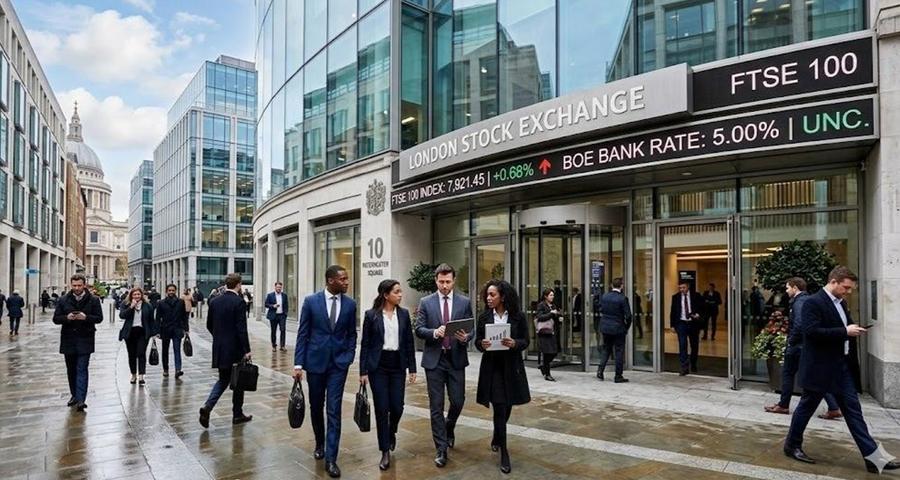
The UK stock market continues to trade close to record levels, with the FTSE 100 maintaining much of the momentum that has carried the index towards the historic 11,000-point mark. Despite geopolitical tensions, changing interest-rate expectations and renewed concerns over inflation, London-listed blue-chip shares have demonstrated notable resilience throughout the summer.
The FTSE 100 reached an intraday record of 10,989.45 points on 31 July 2026, coming within touching distance of 11,000 for the first time. Although the index has since moved below that peak, it remains at historically elevated levels. On 28 August, the FTSE 100 closed at 10,824.26, leaving it roughly 1.5% below its record high.
The performance is particularly significant because it comes against a complicated global economic backdrop. Investors have been dealing with renewed tensions in the Middle East, uncertainty surrounding global interest rates and concerns about the sustainability of elevated valuations in technology stocks. Yet, rather than being dragged lower by these risks, the FTSE 100 has benefited from the distinctive composition of the UK market.
A Different Kind of Stock Market Rally
One of the major reasons behind the FTSE 100's strength is its relatively limited exposure to the technology companies that dominate US equity markets. While technology and semiconductor shares have experienced periods of significant volatility, investors have increasingly looked towards traditional sectors such as energy, mining, banking, healthcare and industrial companies.
This sector composition has helped London become an attractive destination for investors seeking diversification away from expensive technology stocks. The FTSE 100's performance during the global technology sell-off in July highlighted this difference, with the index reaching a new record as investors rotated towards companies viewed as more defensive or attractively valued.
Energy companies have also played an important role. Higher oil prices and continuing geopolitical uncertainty have supported major oil producers, while mining companies have benefited from strong commodity prices and investor demand for natural resources.
Financial stocks have provided another important source of strength. Major UK-listed banks have continued to attract attention as investors assess their profitability, balance sheets and prospects for shareholder returns. HSBC, for example, has seen its shares reach record levels amid strong financial results, cost reductions and growth in wealth management.
Investors Still Watching Interest Rates
Interest rates remain one of the biggest factors influencing the outlook for UK shares.
The Bank of England's future policy decisions will be closely watched as investors attempt to determine whether borrowing costs can eventually move lower or whether persistent inflation could require rates to remain higher for longer.
At the same time, developments in the United States continue to influence global markets. Comments from Federal Reserve Chair Kevin Warsh at the Jackson Hole symposium recently increased expectations that US interest rates could remain higher, creating additional uncertainty for international investors. Nevertheless, UK stocks finished higher on 28 August, with the FTSE 100 gaining 0.3% to 10,824.26.
Could the FTSE 100 Break 11,000?
The obvious question for investors is whether the FTSE 100 can finally move decisively above the psychologically important 11,000 level.
The index has already come extremely close. Its July record of 10,989.45 means that only around 11 points separated the market from 11,000. A sustained move above that level would represent another milestone for London's stock market and could reinforce the perception that UK equities are entering a new phase of strength.
However, investors should not assume that a record high guarantees further gains. Markets can remain volatile even when major indexes are near their peaks. Rising energy prices, geopolitical developments, inflation and central-bank policy could all create periods of pressure.
The broader UK economy also remains an important consideration. A strong stock market does not necessarily mean that every company or sector is performing equally well. The FTSE 100 is heavily influenced by large multinational companies whose revenues are generated around the world, meaning its performance can differ considerably from the health of the domestic British economy.
A Market at an Important Turning Point
For now, the message from London's equity market is one of resilience. The FTSE 100 remains close to its record despite a challenging international environment, while investors continue to find opportunities across energy, financials, mining, industrials and other traditional sectors.
The coming months could therefore be important for UK equities. If corporate earnings remain strong, investor demand continues and global economic conditions stabilise, the FTSE 100 may have another opportunity to challenge — and potentially surpass — the 11,000-point milestone.
For investors watching London, the question is no longer whether the UK market can reach record territory. It already has. The focus now is whether the FTSE 100 can turn its near-record performance into a sustained break above 11,000 and establish a new chapter for the UK's flagship stock index.